Free weekend, day 1

This weekend the study abroad students are free to travel as they please which means the faculty have the same freedom.  The Carpenters went to Prague via Dresden and the Valenzuelas went to Vienna.  Students split into small groups and went everywhere–some to Switzerland, some to Lichtenstein, some to Lake Como, etc.  I decided to take day trips from Schweinfurt and visit some of the Bavarian villages nearby.

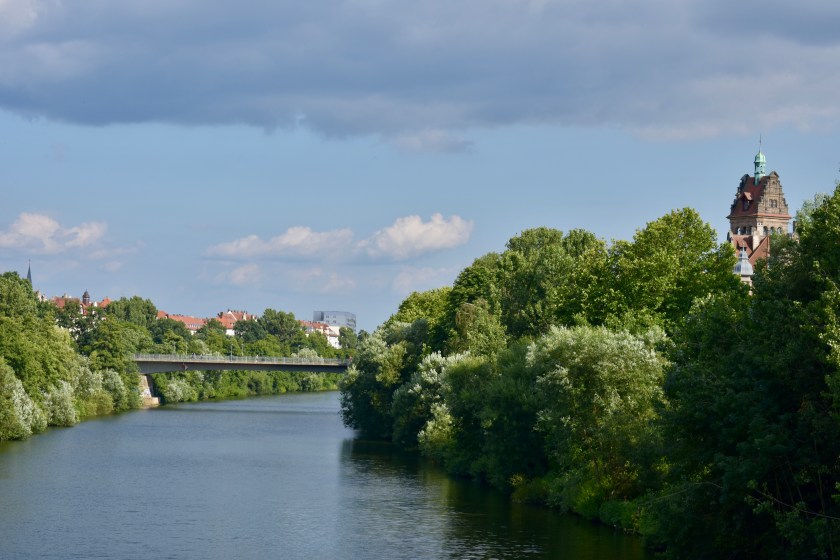
My first stop on Thursday afternoon (the weekend starts early when students are involved) was Bad Kissingen, a spa town about 20 minutes north by train.  The mineral springs here are recorded from as early as 823.  The town went through many names and owners throughout history, becoming known as a “spa town” in the 1500s.  DSC_0001I had no map to the area so I just started walking from the train station.  I saw a field in front of me and a sign that said rose garden so I followed a path, with beautiful rose bushes on either side, that led me to a slow moving stream whose name I don’t know.  I walked on a well-worn path along the stream in a large park with old growth trees (each was labeled by its name and description in German) watching birds and butterflies and crossing bridges from one side to the other.  There were benches along the way to rest.  Eventually I crossed a bridge into a small shopping area–beautiful jewelry stores, small boutiques, and cafes.  I shopped for awhile and admired the beautiful buildings in the area before returning to the train station through the rose garden.

My visit to Bad Kissingen was a perfect start to the free weekend.  I felt free to enjoy the things that I find interesting and beautiful in the world and even rumbling thunder and sprinkles did not stop me.

Fourth of July

Students presented the analysis phase of their projects before we went to Berlin and the improve phase earlier this week.  They have a much better handle on the problems they are solving and how to follow the DMAIC process to find solutions.  Team JOPP developed both a visual breakdown of an actuator that can be included in a reference binder and the framework of a digital representation of an actuator using an Access database.  Team ZF used a multiple attribute decision analysis tool to help the company come to a decision on whether or not to embrace new air damping technology for making shock absorbers.  I am pleased with their work.

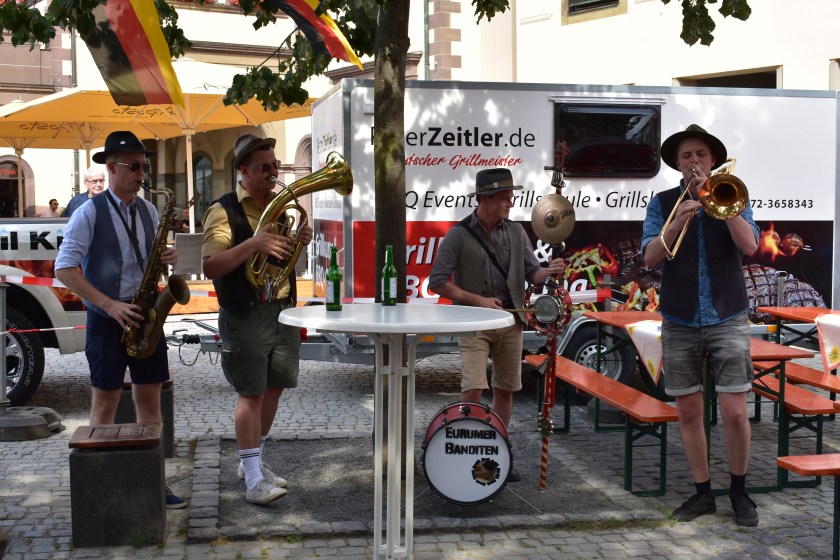
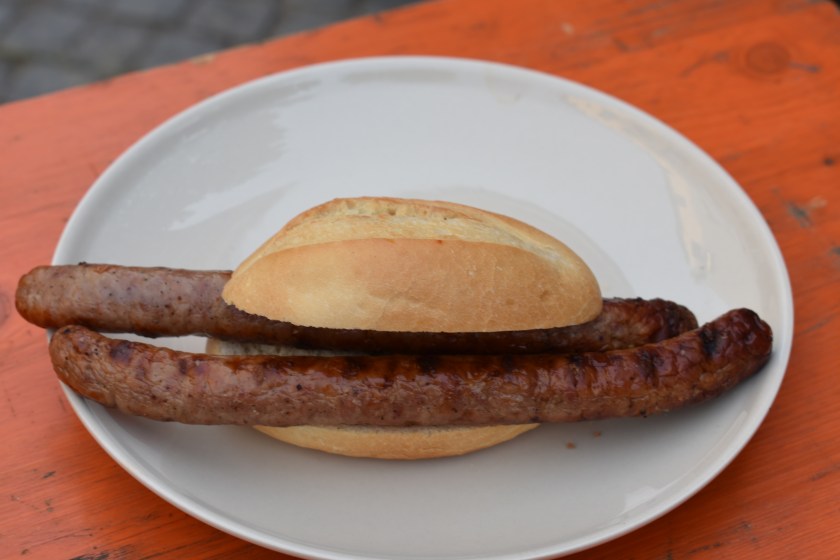
Last evening in front of the Schweinfurt City Hall the mayor of the city and the study abroad program held a Fourth of July party for everyone involved in the program–the AU students, their friends from the local university, professors and administrators from the local university, company representatives, the mayor, and the Auburn faculty.  It was a resounding success!  We had a German folk music band, local beer and wine and hotdogs, hamburgers, chicken on a stick and other sandwiches.

DSC_0207

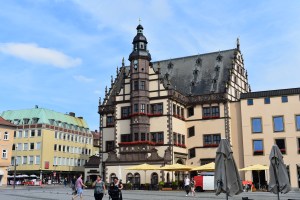
First, the Schweinfurt City Hall is beautiful.  Our event was in the huge cobblestoned plaza underneath some trees.  The weather could not have been better–sunny, breezy and in the high seventies.  While the mayor and friends were setting up with American flags all around, several of the older citizens commented on how much they miss the American presence in the area and how glad they are to see the celebration.  We had an amazing band (friends of the mayor’s son) that played all genres of music with a German folk twist.  Everyone loved them.DSC_0209We were treated to Roth bier–they have a microbrewery in town; wine from Wurzburg, the wine capital of Germany; soft drinks and mineral water.

The mayor gave a short speech about the beautiful words in the Declaration of Independence and how much that document means to the world and, for obvious reasons, Germany.

It was one of the best Fourth of July celebrations I can remember and it was planned by Germans.  I may have to work on hot dogs the Schweinfurt way!

DSC_0245

Berlin

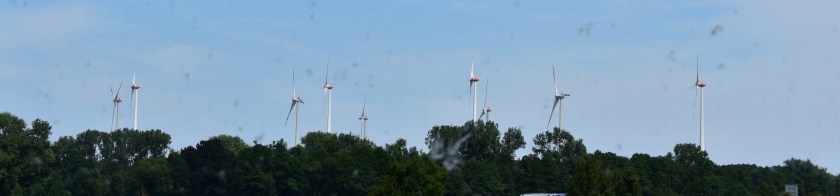
Last weekend was the study abroad program sponsored trip to Berlin.  At 9:00 Friday morning 26 sleepy students and 5 leery adults climbed onto a 60-seat bus.  It took us 6+ hours to get to Berlin, with a 15 minute stop at a populated rest stop along the autobahn and a 30 minute stop at an unpopulated rest stop (go figure). During the first third of the trip, we again enjoyed small green and straw-colored well-manicured fields surrounding villages; we moved to more mountainous terrain covered in coniferous forest with a rare village in a valley; and the last third was the outskirts to Berlin–factories, big sprawling warehouses and eventually modern hi-rise buildings. During the middle third of the trip, we went through tunnels through the mountains.  It seemed that the road was always a straightaway.  Perhaps that is to facilitate traffic speeding along very fast. We talked about the large solar and wind farms all along the way, discussing the opportunities for optimization research the new technology provides to academic institutions.fullsizeoutput_3ae0
At 4:15 we entered the parliament building.  We had pre-planned our visit and had a strict appointment time.  All of us sent our belongings through an X-ray machine, passed through a metal detector, and had our names checked off of a list.  We took group photos in the courtyard and enjoyed our first on the ground glimpse of Berlin.  We climbed the entry steps to find a glass enclosure that only allowed 30 people to enter at a time.  Then we moved on to the elevator, again only allowing 30 people at a time.  We surmised these were anti terror tactics.  Parliament meets on the first floor and to actually see their workings, one must “know” someone.  We didn’t know anyone… Our trip on the elevator took us 4-8 floors above the meeting space to a dome on the roof. DSC_0134 From that vantage point, we could see Berlin laid out all around us.  We followed a ramp in the dome that wound its way up several stories. We each had a headset that must have had a builtin GPS.  It accurately asked us to stop as we approached the important sites, described their roles in history and told us additional history as we continued walking.  It was almost as good a tour of Berlin as the Segway tours we’ve had in other European cities.
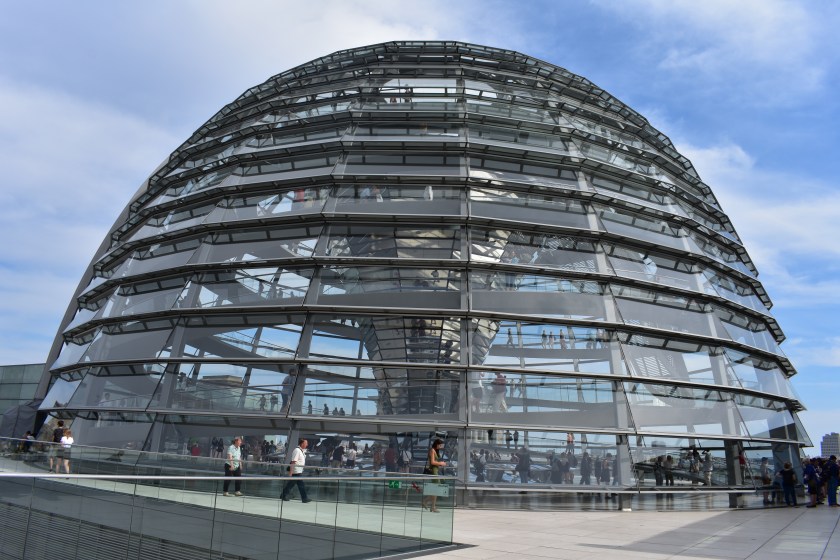
We left Parliament and walked to our hotel past the Brandenburg Gate  (complete with a large screen and stage for watching Germany in FIFA 2018) , the United States embassy and an interesting and moving Holocaust memorial.  The memorial is an art installation with many interpretations discussed by critics.  As with most such installations you need to experience it for yourself to appreciate the effect.


Throughout the city, the wall’s previous location is marked by a trail of double bricks in the roads and sidewalks and at several points along our walk were installations of pieces of the wall marked by descriptions or stories.  Our hotel was a few blocks from Checkpoint Charlie, the best-known Berlin Wall crosspoint point between East and West Berlin during the Cold War (1947-1991).  I think this is the crossing point where our bus was allowed entry to East Berlin when I was here on a tour in 1972.

The train, subway, bus and tram system in Germany is like in all of Europe.  Using public transportation makes even the biggest cities easy to navigate. On our first tour Saturday we took subways and a trams to get to the STASI prison.  It was established in 1951 and in the 1950s, upwards of 11,000 people who were thought to be opposed to the communist dictatorship were incarcerated here.  This facility is a depressing reminder of the atrocities man has imposed on man throughout history and specifically in the time of the Soviet rule of Germany.  We saw the dark and sparse prisoners’ cells, the outdoor cages where prisoners were allowed to spend 20-30 minutes each day, and interrogation rooms where the Soviets worked hard to get confessions from the prisoners.  We spent about 2 hours there and were all ready to get back to a more lively center of the city.

Alexanderplatz is one such lively center.  Originally, a cattle market, today the plaza is a culture, transportation and restaurant hub.  We spent the better part of the remainder of the day here, eating (and drinking) lunch at a Tapas bar called YoSoy and walking.  Next to the restaurant are two alleyways that once were Jewish ghetto housing and now house shops, coffee houses and art galleries.  On the sidewalk outside there are memorial markers for the people who lived there and were killed in the Holocaust.  Today’s German people are ashamed of that part of their history and they seem to bend over backwards to remember and mourn for their countrymen who were treated so inhumanely.

Museum Island is between two forks of the Zwei River and houses several large museums.  We crossed the bridge in front of the Berlin Cathedral at or near closing time so we strolled through the gardens and enjoyed people watching.

Sunday, I walked to the Berlin Art Gallery and enjoyed the peace and quiet inside the large space with only a few visitors.  I was not familiar with the artists and the exhibits were quite somber.

I walked to the Jewish Museum from there, but found that I didn’t have time left to tour.  The courtyard and garden were beautiful outside of the building so I sat and ate a sandwich before strolling through the garden.

And finally we all climbed back on the bus and retraced our ride back to Schweinfurt.

Bamberg

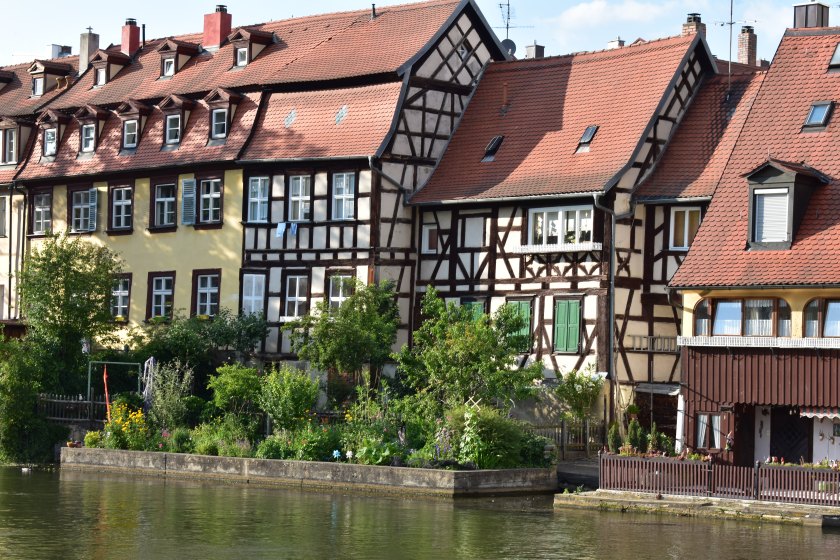
Since we work with the students during the day, the long evenings (16+ hour days) are our time to do some sightseeing.  Tuesday we left Schweinfurt at 4ish and took the train to Bamberg.  It is a beautiful town between two arms of the the Regnitz River.  fullsizeoutput_3ad5LuAnn, her husband Joe and I aimlessly walked around the town for 3 hours.  We saw church steeples in the distance and using sight as our directions finally arrived under the ringing church bells of the romanesque Bamberg Cathedral.  At each half hour, the bells ring for about twenty minutes.  On this particular hill we came across many more than one hill’s share of churches!DSC_0018
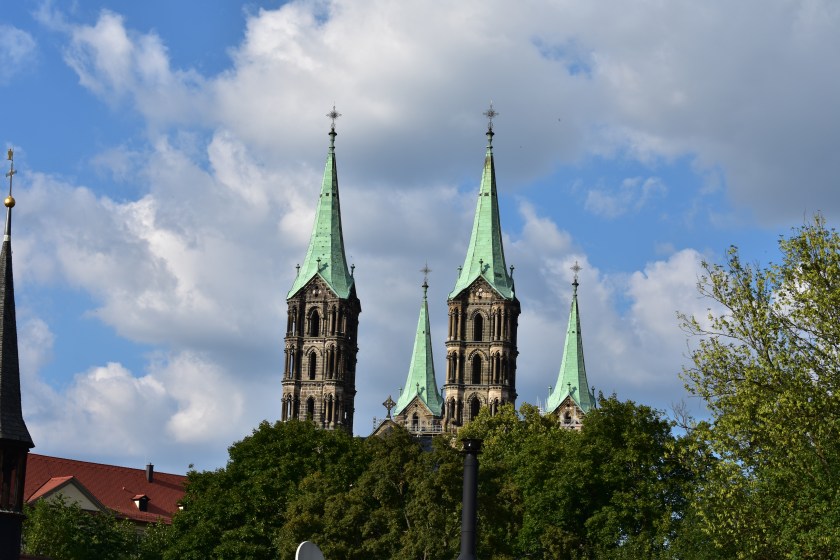
The old town of Bamberg has been a UNESCO World Heritage site since 1993, probably because of its authentic medieval appearance.  We found the town particularly refreshing–the homes along the river are adorned with beautiful flowers and the bridges have flower boxes all long the railing.  Bamberg is very walkable, we began our 4 hour stroll from the train station.DSC_0025

Dr. Valenzuela met us about 7:30 and directed us to old town, his favorite part of Bamberg.  It begins at a stone bridge across the river.  The beautiful, but stately, town hall stands above the bridge.  As soon as we crossed the bridge, we felt the vibe–tourists and locals ambling along the mostly pedestrian streets,  past shops, restaurants and beer gardens.  Bamberg is famous for its micro breweries that are in this area.  We had dinner outside at Scheiners am Doff.  It took us awhile to order since the menu was in German and the waitstaff spoke very little German.  We used Google Translate, LuAnn’s small German/English dictionary, LuAnn’s recently developed German vocabulary, and some intuition to determine our orders.  The food was good, but unlike the French, the portion size was enormous!  After dinner at about 10:30, we returned to the train station and on to Schweinfurt on the 11:02 train.

The Program

I am in Germany with Auburn University as a faculty member in an engineering study abroad program. There are 26 students from several departments within the College of Engineering and they range from rising sophomores to rising seniors.  I, Dr. Valenzuela and Dr. Carpenter came midway through the program to replace faculty who had been here for 3 weeks.  The program is project based so every group of 4-6 students have been assigned an engineering project to work on with a company in or near Schweinfurt.  I am mentoring two teams.  The first team is paired with a company that builds automobile parts. The team’s project is to take apart several actuators, identify the parts, and create a method for the company to query the parts in order to build an actuator according to a customer’s specifications.  They have chosen to build a relational access database to store the parts, specifications and the relationships among the parts of the actuator.  The second team is paired with a company that builds shock absorbers.  They are trying to decide whether to pursue a new air damping technology or stay with the standard product they have been building for years.  These students are building a decision making tool based on attributes of the two different technologies.

Each team uses a six sigma tool called DMAIC–design, measure, analyze, improve, control–to manage their projects.  After each phase is complete, they create a slide about the phase, write a narrative about the phase and make a  presentation to the entire student group, program faculty, program administrators, and company representatives.  The final incorporates all phases into a single presentation.

It is a pleasure to work with these engineering students.  They are all bright and hard working.  Some are very good problem solvers and are eager to try and learn new things; some are unsure of themselves and don’t seem to know how to go about solving a problem; and some simply do what their team mates tell them to do.  Each team has its own personality as do each of the students.  I’m really enjoying the role of a mentoring faculty member in a study abroad program

Arriving in Germany with AU

Arrived safely in Schweinfurt on Monday after a long day.

After the long flight and walk to the train station, navigating the train station was not as easy as I had hoped.  First I didn’t know if Schweinfurt was local or long distance from Frankfurt (it is long distance) and when I was at the red (long distance) kiosk there were 4 stations with Schweinfurt in their names.  So, I found the person-operated ticket counter and quickly had my ticket to Schweinfurt Hbv with a train change at Wurtzburg Hbv (a high speed train).  Leaving from the Frankfort train station the scenery looked much like the United States.  Mixed pine and hardwood forest, fences with wooden fence posts, and birds on wires.  Buildings on the outskirts of Frankfurt are modern–mostly glass and steel–with German names I’ve never heard.  We crossed a metal bridge over a small waterway with lots of graffiti on the way to the Frankfurt Main train station.

Rolling through the countryside, Germany looked more like the countryside in France.  Different colored manicured small fields just outside of small villages with a big-steepled church in each one.

The train from Frankfurt arrived in Wurzburg late enough that the train to Schweinfurt was pulling away as I arrived.  A helpful fellow traveler told me the next train to Schweinfurt was on track 10 (I was on 4) and was leaving in 8 minutes.  I made it even with my 3 heavy bags and lots of stairs, including stairs to the second level of the train.  Note to self:  limit yourself to one bag and a backpack if you might be riding a train.

LuAnn and Dr. Valenzuela picked me up at the train and dropped me at my room with a promise to meet me for dinner.  After unpacking, taking a much needed shower and a short nap, I met them at their hotel; we discussed the program a bit and headed for downtown Schweinfurt and dinner.  We sat upstairs on a terrace and had a great meal of good German food and good German beer.  It was a late night but much fun.

Les Baux

We returned to Lumiére this morning and it was just as incredible this time as it was all of the other times we have been.  We left Allan watching the show one more time and headed to the medieval town of Les Baux.  Charlie, Patti, Connie and I stopped quickly and had a nice lunch at Bautezar, but we were seated at the last available table so Brenda, Clay, Rick and Allan had salads and sandwiches closer to the Chateau.  We walked up to the entrance to the Chateau and I let the others enter without me.  I went shopping by myself and found some interesting shops, art galleries, a lovely tiny church, and a tasty glacerie.  Some of us purchased souvenirs and we all enjoyed our visit to Les Baux.DSC_0030

Our last stop of the day was to Moulin CastelaS for olive oil tasting and purchasing.  The person who toured us through the tasting puts olive oil on everything.  She has each of the 15 or so oils that they sell and uses a different one for different foods–one on toast in the morning, another one on chocolate tarts for dessert, another one on strawberries and other fruit, etc.

Dinner at home was excellent–legume soup, a scrumptious cauliflower recipe (thank you, Brenda), broccoli and asparagus.

Day of Rest…

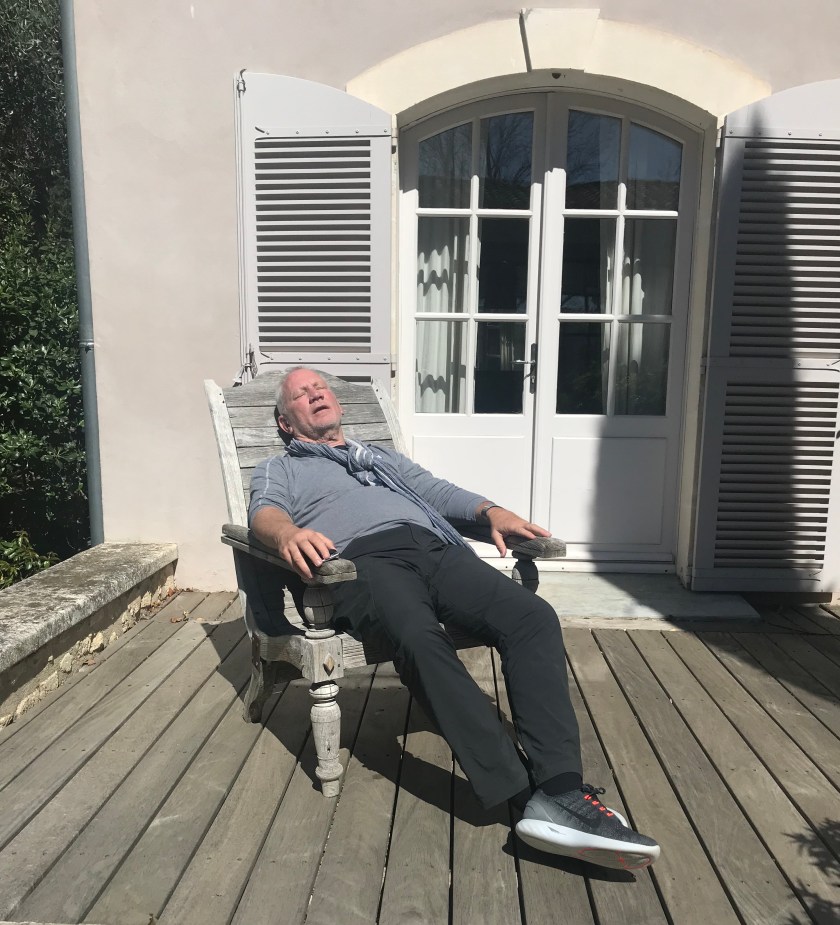
Today, we rested.  Brenda, Rick, Charlie and Patti were still jet-lagged and the rest of us were feeling the effects of lots of wine and too much rich French food.  Rick picked up pastries from the Boulangerie and yogurt from the market and we grazed for most of the morning.  We philosophized, napped, talked and laughed as we moved from room to room, in and out of the villa.fullsizeoutput_3871  Eventually, we walked into Maussane and had a light lunch at the Cafe de la Fountaine, sitting outside in the town square and admiring the plane trees just beginning to leaf out.

It was one of those incredibly clear, bright days that are so beautiful in Provence…no wonder so many artists took advantage of the colors and painted here.  After lunch we napped and talked some more.  Charlie and Patti explored the five-star country club down the road.  Dinner was another finish-what’s-here kind of event and we turned in relatively early.

Aux Ateliers


fullsizeoutput_3841

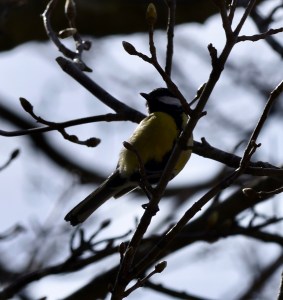
This morning everyone except me went to Arles for the Saturday market.  This market is the biggest one we’ve been to and I can attest from the last two years that it is huge!  I spent the morning working on the blog, relaxing, and looking for birds. This Great Tit was in the tree outside the big living room window.  It is a very common bird in all of Europe and  has a beautiful song, usually heard from high up in the trees.

We lunched at Aux Ateliers, a favorite spot for both locals and tourists in Maussane.  We spent more than 2 hours eating our entree (appetizer), plat (main dish) and, of course, dessert and shared 3 bottles of rosé wine.  After lunch, we shopped a bit at the boutique there and Allan, Clay, Charlie and Rick played a rousing game of Pétanque.

Next stop was the Domaine Romanin winery.  Just past St. Remy, it is tucked into the edge of a mountain and one of the walls of the cave (cellar) is the mountain.  Because of that the temperature stays at 15 degrees celsius and the humidity at 60% all of the time–day and night.  We toured the facility and it is beautiful!  The winery is designed like a cathedral.  The wine in this AOC is 60% syrah grapes.  Each AOC sets the grapes that can be included in the mixture to be bottled and the wine in this AOC is syrah, cabernet sauvignon, among other grapes.  The wine we liked best is 60% syrah grapes. We tasted the wine and Allan, Connie and Brenda bought some for happy hour and some for bringing home.

Dinner tonight was “catch as catch can” of all of our leftovers and, of course, baguettes and butter.

Course de Carmarguaise

This morning Clay and Allan picked up Brenda and Rick from their overnight stay in Avignon and brought them to the villa to unpack a bit before our drive to the Eygalieres market.  It is one of our favorites–snakes through the streets at the bottom of the hill and proceeds to the top of the hill in the center of town.  This market is where Clay historically buys ladles and spoons made of horn.  We all shopped (and bought) here before ducking in to Gilles for a tasty lunch of pizza (Italian with a French twist–goat cheese and jambon, for example) and a bottle of wine.

We dropped Connie at the villa to wait for Charlie and Patti, arriving from Marseilles around 4 PM.  And, the five of us drove to Arles for the Course de Carmarguaise (a sporting match between two teams (8 men each) of people, all working to remove ribbons from a small, sturdy,  fast bull’s horns.  We watched 7 bulls compete. The competition takes place in the Arles Coliseum, built by the Romans in 90 A.D., this and others throughout Europe are clearly the model for our modern sporting venues.  Pageantry introduces the games, but we didn’t understand French well enough to know who was presented to us.  The beautiful Camargue horses (herds of them run wild in the Rhone Delta called the Camargue) strutted and carried this year’s royalty.

As in all of the games associated with bullfighting, this one doesn’t seem fair to the bull.  There are 16 people that the bull has to deal with and he is teased and bothered by them throughout his 15 minutes in the ring.  The men work hard using a claw-shaped metal instrument called a raset  in their hands to get two white rosettes off of the horns and a red rosette from between the horns before removing the twine wrapped around each horn, and all while the bull charges them.  Two men on each team are the teasers and the other six are the raseteurs.

When the men are chased by a charging bull, they step on a white step at the bottom of the red fence, tap the top of the fence and fly over, grabbing a metal bar and dropping to the ground safely behind the red fence.  Often the bull runs around the entire ring, sending all 16 men scrambling over the fence.

The Arles Coliseum and the historic town of Arles are beautiful and I couldn’t resist a few photos as we walked through the town to our car.

Dinner included all 8 of us, Charlie and Patti arrived safely from Marseilles.  We ate at home again, sure that our newest arrivals would be exhausted from their travels.  Happy hour was happy;  supper was super; and the bed was quite welcome.